



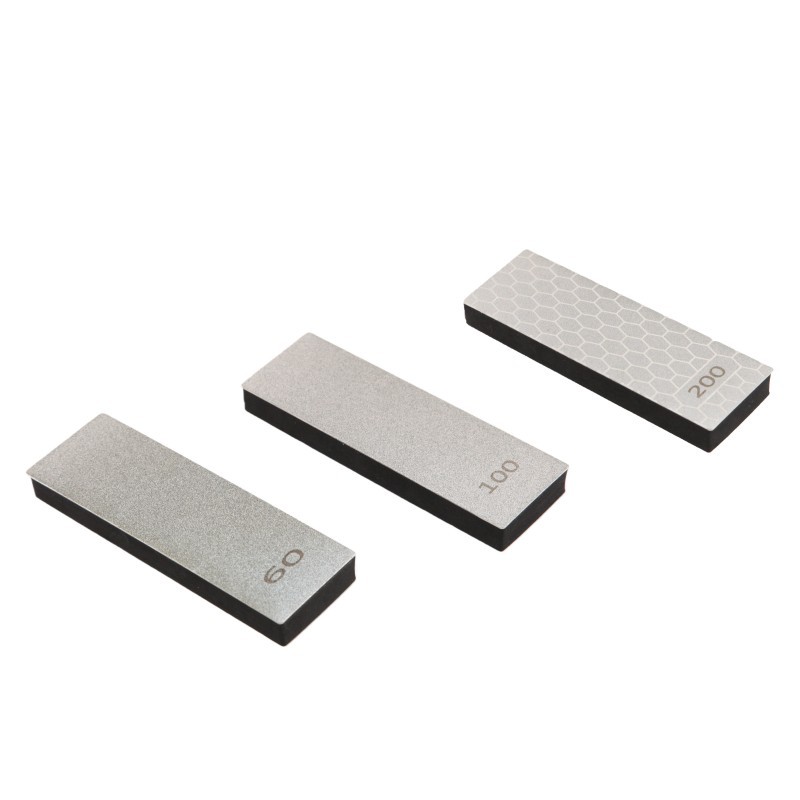
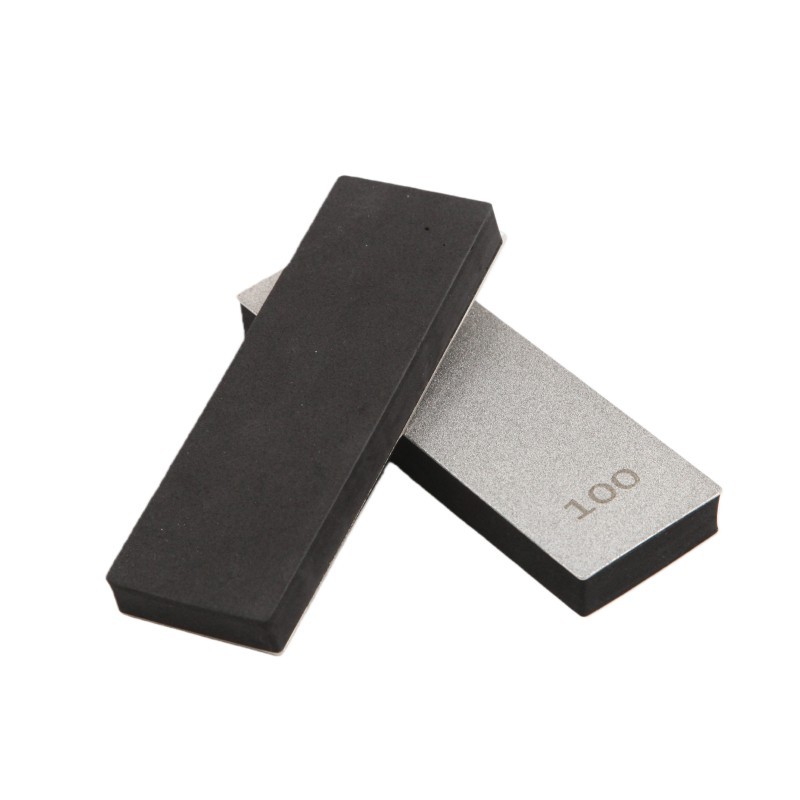
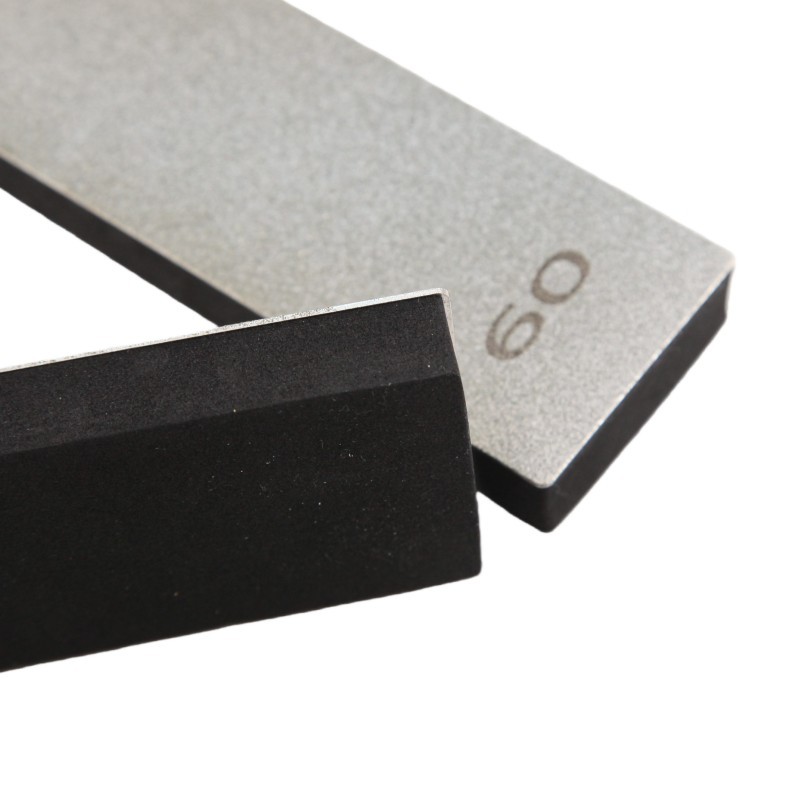
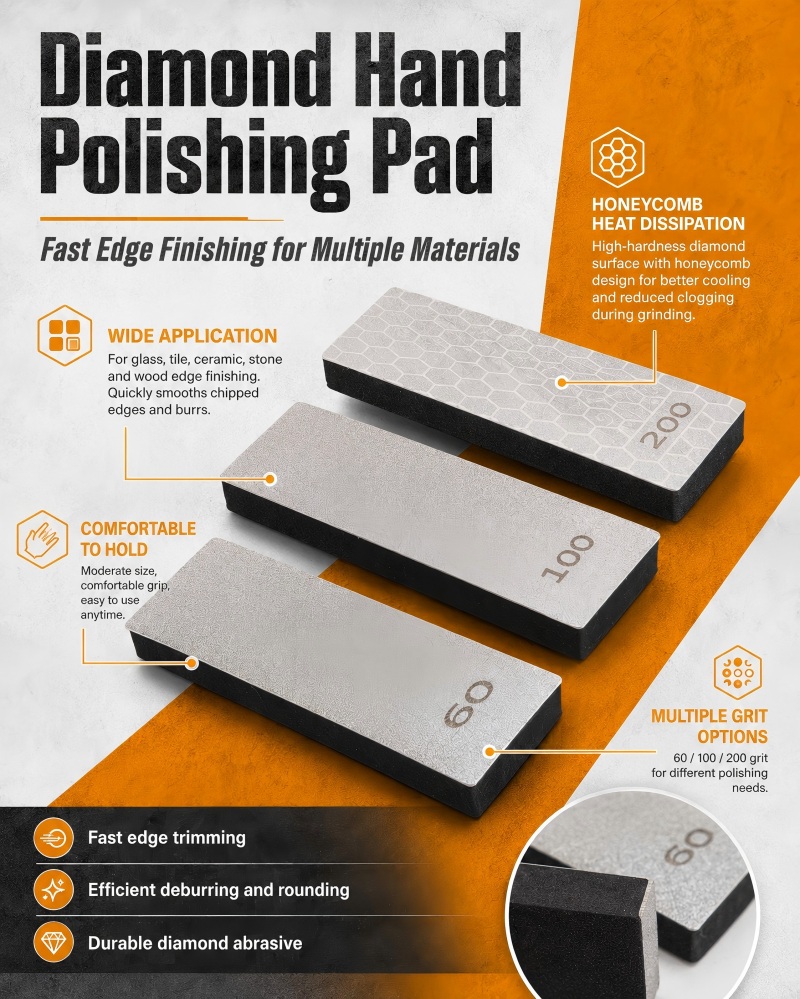
The GUSHI Diamond Hand Polishing Pad is an electroplated diamond abrasive hand tool designed for fast edge finishing, deburring, and surface refinement across a wide range of hard and brittle materials. Manufactured by Huzhou Gu's Imp. & Exp. Co., Ltd. (established 2004), this pad features a honeycomb surface design that improves heat dissipation and dust discharge during continuous grinding. With grit options from 50# to 3000#, it covers the full sequence from coarse material removal to high-gloss polishing — all without requiring a machine. ISO 9001 quality certified and CE marked, it is trusted by stone fabricators, tile installers, glass workers, and construction professionals in 20+ countries worldwide.
Unlike conventional silicon carbide hand pads that wear out quickly and lose cutting efficiency, the GUSHI diamond hand polishing pad uses industrial diamond particles (Mohs 10 hardness) electroplated onto a durable backing. This construction maintains consistent cutting force throughout the pad's lifespan, delivering 3-5 times more working surface area than equivalent SiC pads. The honeycomb pattern on the working surface serves a dual purpose: it channels grinding dust away from the contact zone to prevent clogging, and it creates air gaps that dissipate heat — a critical factor when working on dense materials like granite and porcelain.
Available in four sizes (80mm, 100mm, 125mm, 180mm) and seven grit grades (50, 100, 200, 400, 800, 1500, 3000), the pad adapts to jobs ranging from heavy edge shaping to final mirror polishing. Its compact form factor and comfortable grip make it ideal for detail work, repair jobs, and on-site adjustments where bringing a polishing machine is impractical. For OEM customers, custom branding, packaging, and grit combinations are available with a minimum order of 500 pieces.
| Parameter | Specification |
|---|---|
| Product Name | GUSHI Diamond Hand Polishing Pad |
| Model | HZFPPB |
| Brand | GUSHI (OEM available) |
| Abrasive Type | Electroplated diamond |
| Diamond Hardness | Mohs 10 (industrial diamond) |
| Grit Range | 50#, 100#, 200#, 400#, 800#, 1500#, 3000# |
| Available Sizes | 80mm / 100mm (4") / 125mm (5") / 180mm |
| Surface Design | Honeycomb pattern |
| Use Mode | Wet and dry |
| Backing Material | Resin bond + sponge backing |
| Compatible Materials | Natural stone, glass, ceramic/porcelain tile, granite, marble, concrete, quartz, terrazzo, hard alloys |
| Certifications | ISO 9001, CE, EN13236 |
| Production Capacity | 100,000 sets / month |
| Price Range | US$1.60 – $7.00 / piece |
| MOQ (OEM) | 500 pieces |
| Lead Time | 15-25 days (depending on volume) |
| Package | Carton box; custom packaging available |
| Origin | Huzhou, Zhejiang, China |
| Manufacturer | Huzhou Gu's Imp. & Exp. Co., Ltd. (Since 2004) |
The GUSHI diamond hand polishing pad operates on the principle of bonded abrasive machining. Industrial diamond particles — the hardest natural material known at Mohs 10 — are electroplated onto the pad's working surface. During use, these exposed diamond edges cut into the workpiece material through micro-fracture: each diamond grain removes tiny chips of material as the pad moves across the surface.
The electroplating process bonds diamond particles to a metal substrate using a nickel matrix. This creates a single-layer abrasive surface where the diamond grit is locked firmly in place. As the pad wears, fresh diamond edges are continuously exposed, maintaining consistent cutting performance throughout the pad's lifespan — unlike silicon carbide pads whose abrasive grains dislodge and the pad quickly becomes smooth and ineffective.
The honeycomb surface design is a key innovation. The hexagonal cells create channels between the diamond-coated contact points. During grinding, these channels serve two functions: (1) they allow grinding dust and swarf to exit the contact zone, preventing clogging that would reduce cutting efficiency, and (2) they create air gaps that improve heat dissipation, which is critical when working on dense materials like granite and porcelain where friction temperatures can damage both the pad and the workpiece.
The GUSHI diamond hand polishing pad is versatile enough for professional fabrication shops and on-site installation work. Its primary applications include:
| Application | Details |
|---|---|
| Edge Finishing | Smoothing chipped or rough edges after cutting on tile, glass, stone slabs |
| Deburring | Removing burrs and sharp protrusions on cut materials |
| Corner Rounding | Rounding sharp corners on countertops, tile edges, stone steps |
| Surface Refinement | Refining surfaces after machine cutting or installation |
| Seam Blending | Blending seams between adjacent stone or tile pieces |
| Repair Work | Fixing chips, scratches, and minor surface damage on installed materials |
| Detail Polishing | Polishing small areas, curves, and profiles that machines cannot reach |
| Material Category | Specific Materials | Recommended Starting Grit |
|---|---|---|
| Natural Stone | Granite, marble, limestone, sandstone, slate | 50-100 |
| Engineered Stone | Quartz, terrazzo, concrete | 100 |
| Glass | Art glass, stained glass, fused glass, optical glass | 100-200 |
| Ceramics | Porcelain tile, ceramic tile, fired clay | 100 |
| Hard Alloys | Carbide, hardened steel parts | 200-400 |
Selecting the correct grit sequence is essential for achieving a professional finish. Always progress through grits sequentially — never skip more than one grit step, or the scratches from the previous stage will remain visible in the final finish.
| Grit | Stage | Best For | Typical Use |
|---|---|---|---|
| 50# | Coarse grinding | Rapid material removal, shaping rough edges | Removing deep scratches, heavy stock removal |
| 100# | Medium-coarse | Surface leveling after 50# grit | Edge shaping, initial smoothing |
| 200# | Medium | Scratch removal from 100# stage | Surface smoothing, pre-polish prep |
| 400# | Medium-fine | Removing 200# scratches | Fine surface preparation |
| 800# | Fine | Pre-polish smoothing | Preparing for high-gloss stages |
| 1500# | Ultra-fine | High-gloss preparation | Near-final polishing |
| 3000# | Final polish | Mirror finish, final gloss | Achieving maximum shine on stone and glass |
Many professionals ask whether a diamond hand polishing pad is worth the higher initial cost compared to traditional silicon carbide (SiC) hand pads. The answer depends on your material hardness, volume of work, and desired finish quality. Here is a detailed comparison:
| Comparison Factor | GUSHI Diamond Hand Pad | Silicon Carbide Hand Pad |
|---|---|---|
| Abrasive Material | Industrial diamond (Mohs 10) | Silicon carbide (Mohs 9-9.5) |
| Cutting Efficiency | High — consistent force maintained | Declines rapidly as grit dislodges |
| Lifespan | 3-5× longer than SiC equivalent | Short; treated as disposable |
| Hard Material Performance | Excellent on granite, porcelain, quartz | Struggles on dense/hard materials |
| Heat Dissipation | Honeycomb design reduces heat buildup | Flat surface — heat accumulates |
| Clogging Resistance | Honeycomb channels discharge dust | Prone to clogging on soft materials |
| Finish Quality | Consistent, professional-grade | Adequate but variable |
| Initial Cost | Higher per piece (US$1.60-$7.00) | Lower per piece |
| Long-term Cost | Lower — fewer replacements needed | Higher — frequent replacement |
| Wet/Dry Use | Both supported | Dry (velour-backed); wet only above P400 |
| Best For | Hard materials, professional use, volume work | Soft materials, low-volume jobs, budget projects |
Bottom line: For professional stone fabricators and tile installers working on granite, porcelain, or quartz, the GUSHI diamond hand polishing pad delivers superior value over time despite the higher upfront cost. For occasional DIY work on soft marble or limestone, SiC pads remain a reasonable budget option.
The GUSHI diamond hand polishing pad is rated for both wet and dry use. Understanding when to choose each method is important for achieving optimal results:
| Factor | Wet Polishing | Dry Polishing |
|---|---|---|
| Pad Life | 40-60% longer (water cools abrasive) | Standard lifespan |
| Finish Quality | Best — mirror gloss achievable | Very good — close to wet finish |
| Dust | None — water suppresses dust | Significant — respiratory protection needed |
| Best Application | Workshop, fabrication shop, outdoor | Finished/installed surfaces, indoor sites |
| Speed | Slightly slower (setup) | Faster (no water setup needed) |
| Recommended Grits | All grits (50#-3000#) | Best with 100#-400# |
For more detailed guidance on diamond polishing techniques, see our related guides on choosing the right grit for your project and professional stone edge finishing techniques.
Start with 60 grit (or 50#) for heavy material removal and shaping rough edges. If the surface is already reasonably smooth, begin with 100 or 200 grit. Always work through grits progressively — each grit removes the scratches left by the previous coarser grit. For a high-gloss finish, work through 50, 100, 200, 400, 800, 1500, and 3000 grit in order.
Both wet and dry use are supported. Wet use is strongly recommended because water cools the diamond abrasive, prevents glazing, extends pad life by 40-60%, and suppresses harmful dust. Dry use is suitable for on-site finishing where water is impractical, but wear appropriate respiratory protection, especially when working on engineered stone.
The pad works on natural stone (marble, granite, slate, sandstone, limestone), glass, ceramic and porcelain tile, engineered stone (quartz, terrazzo), concrete, and hard alloys. The diamond abrasive (Mohs 10 hardness) makes it effective on materials where silicon carbide pads struggle.
Available in four sizes: 80mm, 100mm (4 inch), 125mm (5 inch), and 180mm. The 100mm and 125mm sizes are the most popular for general edge finishing. Custom sizes are available for OEM orders with a minimum quantity of 500 pieces.
With proper wet use, each pad lasts 3-5 times longer than a silicon carbide hand pad of equivalent grit. The electroplated diamond surface maintains consistent cutting force throughout its lifespan. Our production capacity is 100,000 sets per month, ensuring stable supply for wholesale and OEM customers.
The OEM MOQ is 500 pieces for diamond hand polishing pads. Custom branding, packaging, grit combinations, and sizes are available. Lead time is typically 15-25 days depending on order volume. Contact us via WhatsApp at +86 133 2582 1813 for a detailed quote.
The honeycomb pattern on the pad surface improves heat dissipation during grinding, reduces clogging by allowing grinding dust to discharge smoothly, and maintains consistent contact pressure across the work surface. This design extends pad life and delivers a smoother grinding experience during continuous operation.
Yes. GUSHI diamond hand polishing pads are manufactured under ISO 9001 quality management, carry CE marking, and comply with EN13236 safety standards for diamond tools. We also hold RoHS compliance. These certifications are accepted in 20+ countries including the USA, Canada, Germany, UK, Netherlands, Italy, Portugal, Poland, Czech Republic, Brazil, Chile, Australia, and South Africa.
| Parameter | Details |
|---|---|
| OEM MOQ | 500 pieces |
| Custom Branding | Yes — your logo on pad backing and packaging |
| Custom Packaging | Yes — retail-ready packaging, blister packs, or bulk cartons |
| Custom Grit Sets | Yes — choose any combination of grits from 50# to 3000# |
| Custom Sizes | Yes — non-standard dimensions available |
| Sample Policy | Free samples available; shipping cost by buyer |
| Payment Terms | L/C, T/T, Western Union, PayPal |
| Port of Loading | Shanghai, China |
| Languages Supported | English, Spanish, Japanese, Russian, French, German |
Huzhou Gu's Imp. & Exp. Co., Ltd. has been manufacturing diamond tools since 2004. We were one of 23 Chinese companies that won the anti-dumping case for diamond blades to the USA market, securing a 6.2% anti-dumping tariff rate. Many of our customers have been working with us for over 10 years. We offer solutions and services — not just products. Our professional sales team provides a positive reply or solution within 24 hours.
Explore our full range of diamond polishing tools: Flexible Diamond Polishing Pads (for machine use), Diamond Cup Wheels, and Diamond Core Drill Bits.