




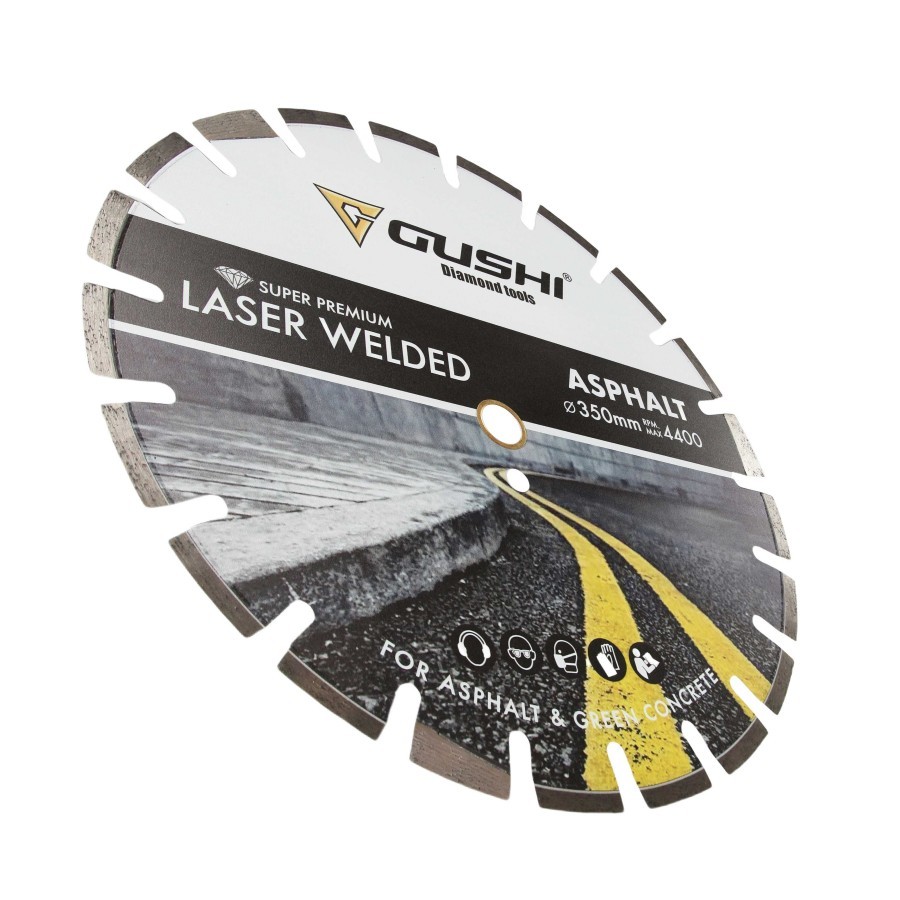
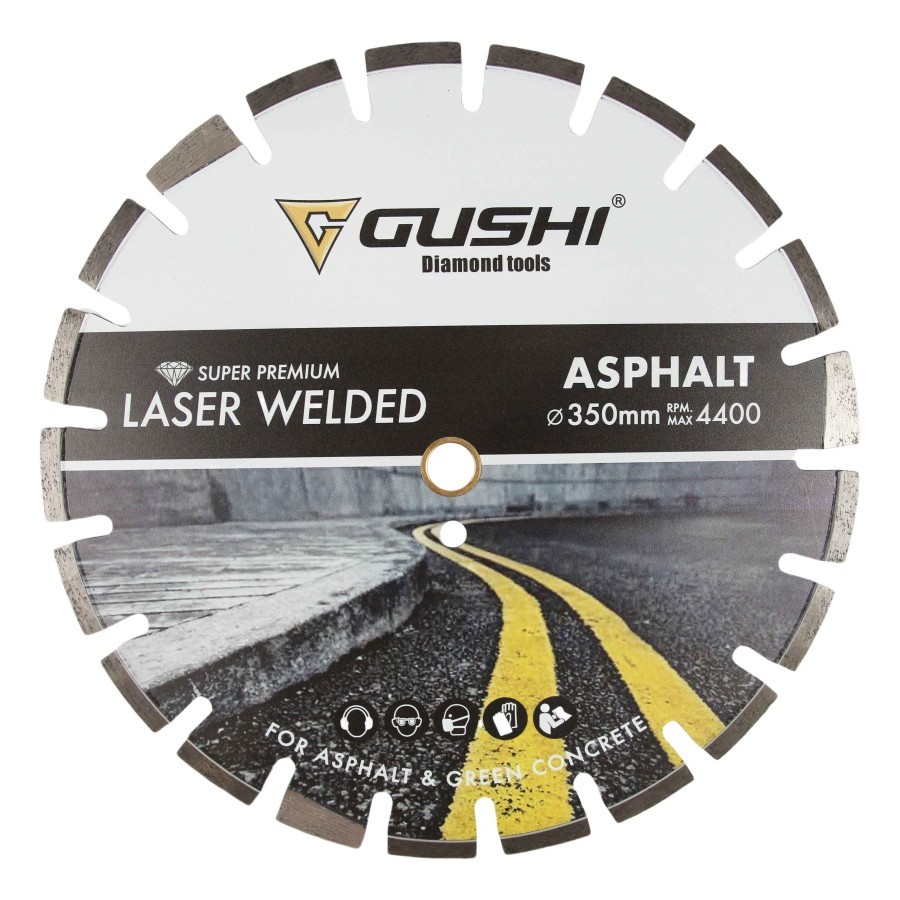
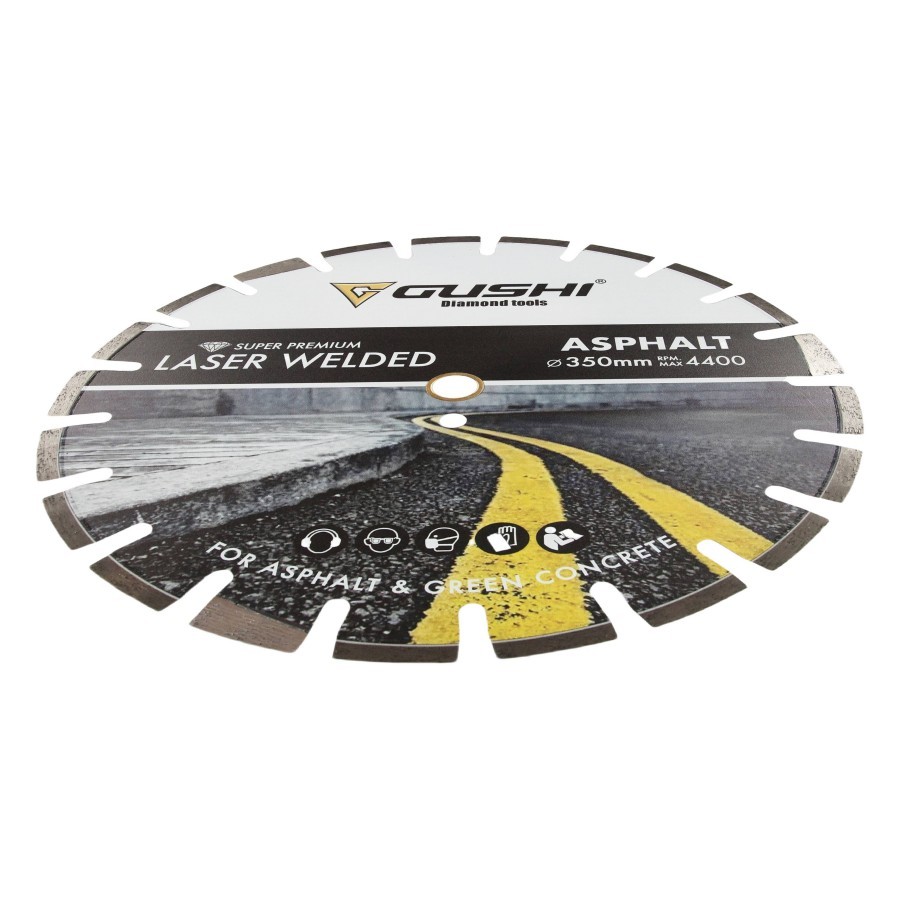
The GUSHI Roycel Concrete Diamond Cutting Blade is a laser-welded segmented diamond blade engineered for cured concrete, green concrete, asphalt, reinforced concrete, brick, block and masonry. Manufactured by Huzhou Gu's Imp. & Exp. Co., Ltd. — a diamond tool specialist founded in 2004 and ISO 9001, CE, EN13236 and RoHS certified — the deep gulleted segmented rim vents heat and flushes slurry for fast, cool cutting on walk-behind saws, road cutters, handheld cut-off saws and angle grinders, wet or dry. With a production capacity of 100,000 diamond-tool sets per month, GUSHI exports to 20+ countries including the USA, Germany, UK, Australia and Brazil.
Unlike tile and turbo blades tuned for chip-free edges on brittle surfaces, the concrete blade is built for raw cutting power on hard, abrasive mass. Its gulleted segmented rim dissipates the intense heat of concrete and asphalt work and ejects the slurry that would otherwise clog a continuous rim. Contractors, road crews and construction rental houses choose it for joint cutting, slab demolition, trenching and asphalt repair where depth, speed and blade life outweigh surface finish.
GUSHI is one of only 23 Chinese manufacturers that won the anti-dumping case for diamond blades exported to the USA, holding a 6.2% tariff rate. That compliance heritage, plus in-house laser welding and per-lot segment and flatness inspection, makes the concrete blade a dependable specification for distributors and OEM partners serving regulated and quality-sensitive markets.
| Parameter | Specification |
|---|---|
| Product Name | GUSHI Roycel Concrete Diamond Cutting Blade |
| Model Number | GSDB-CT Series |
| Blade Type | Laser-welded segmented diamond blade |
| Diameter Range | 105 – 600 mm (4" – 24") |
| Arbor / Bore | 20 / 22.23 / 25.4 mm (1" with pin holes) |
| Segment (Kerf) Thickness | 2.4 – 4.2 mm |
| Segment Height | 7 / 10 / 12 / 14 mm |
| Rim Type | Gulleted segmented rim |
| Diamond Matrix | Laser-welded synthetic diamond |
| Bond | Hard / medium / soft-medium, material-matched |
| Core | Reinforced steel body |
| Max RPM | 3,400 – 15,000 (by diameter) |
| Peripheral Speed | Up to 80 m/s |
| Cutting Mode | Wet and dry |
| Applications | Cured concrete, green concrete, asphalt, reinforced concrete, brick, block, masonry, pavers, stone |
| Machines | Walk-behind saw, road cutter, cut-off saw, angle grinder |
| Certifications | ISO 9001, CE, EN13236, RoHS, SGS |
| Safety Standard | EN13236 (diamond tool safety) |
| Segment Process | Laser welded |
| Packaging | Blister / white box / carton |
| HS Code | 8202.39 |
| MOQ | 500 pieces |
| Lead Time | 25 – 30 days |
| Port of Loading | Shanghai / Ningbo, China |
The rim is divided into discrete diamond segments separated by deep slots (gullets). As the blade spins, each gullet opens a gap that releases the heat built up at the cut face and channels slurry, water and dust out of the kerf. This airflow is essential in concrete and asphalt work, where a continuous rim would quickly overheat, glaze and stop cutting.
The diamond segments are fused to the steel core by laser welding, creating a joint far stronger than brazing or sintering. Laser-welded segments resist the impact and heat of cutting rebar and abrasive aggregate, so they stay attached at high RPM and under heavy feed — the safety-critical requirement for concrete and road saws.
The metal bond holding the diamond is chosen to match the job. Abrasive materials like green concrete and asphalt wear diamond quickly, so a hard bond holds the grit longer. Hard, dense materials like cured and reinforced concrete "swallow" diamond, so a soft-medium bond releases spent grit to expose fresh diamond and keep the blade cutting. Selecting the right bond is the single biggest factor in cut speed and blade life.
Laser-welded segments survive the shock of hitting rebar and the sustained heat of long slab cuts — a safety and durability requirement that brazed blades cannot match on concrete saws.
The segmented rim's gullets vent heat and flush slurry, keeping the blade cool and free-cutting through abrasive concrete and asphalt where a continuous rim would glaze over.
Hard bond for green concrete and asphalt, soft-medium for cured and reinforced concrete, medium for brick and block. The right bond maximizes cut speed and blade life and avoids the slow-cutting "wrong bond" failure mode.
A reinforced steel core with damped geometry runs true and straight at high RPM, reducing vibration for cleaner, safer cuts on walk-behind and handheld saws.
From 105 mm angle-grinder sizes to 600 mm ride-on road-saw blades, with 20, 22.23 and 25.4 mm (1") arbors and pin holes — one supplier covers a contractor's whole concrete-cutting fleet.
Every blade is manufactured and tested to the EN13236 diamond-tool safety standard, the European benchmark for rotating diamond tools. QC includes flatness, segment and core inspection, with SGS inspection available on request.
Match diameter, arbor and bond to your saw and the material. Small 105–230 mm blades with 20/22.23 mm arbors fit angle grinders and handheld cut-off saws; 300 mm and larger blades with 25.4 mm (1") arbors fit walk-behind and road saws.
| Diameter | Arbor (mm) | Machine | Best For |
|---|---|---|---|
| 105 mm (4") | 20 | Angle grinder | Light scoring, brick, block |
| 125 mm (5") | 22.23 | Angle grinder, cut-off saw | Curbs, pavers, masonry |
| 180 mm (7") | 22.23 | Cut-off saw | Rebar, small slabs |
| 230 mm (9") | 22.23 | Cut-off saw | Concrete, asphalt patch |
| 300 mm (12") | 25.4 | Walk-behind saw | Joint cutting, slabs |
| 350 mm (14") | 25.4 | Walk-behind / road saw | Cured concrete, asphalt |
| 400 mm (16") | 25.4 | Road / floor saw | Deep slab, green concrete |
| 450 mm (18") | 25.4 | Road saw | Highway, reinforced concrete |
| 500–600 mm (20–24") | 25.4 | Ride-on road saw | Heavy road & runway cutting |
| Application | Recommended Bond |
|---|---|
| Cured concrete joint / slab cutting | Soft–medium bond |
| Reinforced concrete (rebar) | Soft–medium bond |
| Green (fresh) concrete | Hard bond |
| Asphalt & overlay | Hard bond |
| Brick, block, masonry | Medium bond |
| Pavers, stone, granite | Medium–soft bond |
| Material | Bond | Cutting Mode |
|---|---|---|
| Cured concrete | Soft–medium | Wet preferred / dry |
| Green concrete | Hard | Wet / dry |
| Asphalt | Hard | Wet / dry |
| Reinforced concrete | Soft–medium | Wet preferred |
| Brick, block, masonry | Medium | Wet / dry |
| Natural stone, granite | Medium–soft | Wet |
These are both diamond blades, but they are built for opposite jobs. The table compares the GUSHI concrete (segmented) blade with a turbo/continuous tile blade at a similar diameter.
| Dimension | Segmented Concrete (GUSHI) | Turbo / Continuous Tile Blade |
|---|---|---|
| Rim design | Gulleted segmented (vents heat) | Continuous / turbo (sealed) |
| Best material | Concrete, asphalt, masonry | Porcelain, ceramic tile |
| Cutting depth / speed | Deep, fast on mass | Shallow, slower on mass |
| Cooling on abrasive cut | Excellent (gullets) | Clogs, overheats |
| Reinforced concrete / rebar | Cuts through | Poor |
| Edge finish | Rough, structural | Chip-free, smooth |
| Lifespan on concrete | Long | Very short / fails |
| Lifespan on tile | Short (overkill) | Long |
| Wet / dry use | Both (heavy duty) | Both |
| Vibration | Damped core, steady | Low |
| Best for | Construction, roads, demo | Tiling, indoor finish |
| Initial cost | Lower per mm cut | Higher |
Bottom line: Choose the segmented concrete blade for cured/green concrete, asphalt, reinforced concrete, brick and masonry — anything structural where depth, cooling and blade life decide the job. Choose a turbo or mesh blade for porcelain, ceramic and fine stone where chip-free edges matter.
For related concrete work, see our guides on Diamond Core Drill Bits, Diamond Cup Grinding Wheels, and Super Thin Turbo Diamond Blades.
A concrete diamond cutting blade is a laser-welded segmented blade with deep gullets between segments. The gullets vent heat and flush slurry, so the blade stays cool and cuts fast through abrasive, hard materials like cured and green concrete, asphalt and masonry. A tile/turbo blade has a thin continuous or turbo rim tuned for chip-free edges on brittle porcelain — it would clog and overheat on concrete. For concrete and asphalt you need the gulleted segmented blade.
It cuts cured concrete, green (fresh) concrete, asphalt, reinforced concrete (rebar), brick, block, masonry, pavers, overlay, stone and granite. The bond is selected to the job: a hard bond for abrasive green concrete and asphalt, a soft-medium bond for cured and reinforced concrete, and a medium bond for brick, block and general masonry.
Yes. The blade is rated for both wet and dry cutting. Wet cutting (on walk-behind saws and road cutters) suppresses dust, cools the rim and extends life — preferred for long joint and slab cuts. Dry cutting works on handheld cut-off saws and angle grinders for fast on-site scoring; use moderate feed and allow cool-down pauses to protect the laser-welded segments.
Diameters range from 105 mm (4") for angle grinders up to 600 mm (24") for ride-on road saws, with common 300/350/400/450/500 mm sizes for walk-behind cutters. Small 105-230 mm blades use 20 or 22.23 mm arbors; 300 mm and larger blades use a 25.4 mm (1") arbor with pin holes for concrete and road saws. Segment height options are 7, 10, 12 and 14 mm.
Match the bond to material abrasiveness. Green (fresh) concrete and asphalt are highly abrasive and wear diamond fast, so use a hard bond that holds grit longer. Cured and reinforced concrete are harder and 'swallow' diamond, so use a soft-medium bond that releases spent grit to keep cutting. Choosing the wrong bond is the most common cause of slow cutting and short blade life.
Yes, up to a point. A soft-medium bonded segmented blade cuts through occasional rebar, though steel dulls diamond faster than concrete. Keep water flowing and avoid twisting when you hit steel; for heavily reinforced sections a dedicated soft-bond blade or wall/channel saw is the better tool. The laser-welded segments are designed to resist loss on impact with rebar.
OEM and private-label MOQ is 500 pieces per specification. Standard production lead time is 25-30 days after artwork and sample confirmation. Custom branding (laser marking, silk screen or printed stickers), packaging and bond formulas are available. Samples are supplied at cost price with the buyer paying shipping. Payment via L/C, T/T, Western Union or PayPal. Port of loading: Shanghai or Ningbo.
Yes. GUSHI concrete blades are manufactured under ISO 9001:2015, carry CE marking and RoHS compliance, and are tested to the EN13236 diamond-tool safety standard that governs European diamond-blade use. Each blade is flatness-checked with laser-welded segment and core inspection, and SGS inspection is available on request.
| Parameter | Specification |
|---|---|
| Minimum Order Quantity | 500 pieces per specification |
| Production Lead Time | 25 – 30 days after sample & artwork confirmation |
| Custom Branding | Laser marking, silk screen, printed stickers |
| Custom Packaging | Blister, white box, carton |
| Custom Specifications | Diameter, kerf, segment height, bond per RFQ |
| Sample Policy | Available at cost price; buyer pays shipping |
| Payment Terms | L/C, T/T, Western Union, PayPal |
| Port of Loading | Shanghai or Ningbo, China |
| QC Documentation | Flatness, segment & core inspection per lot, SGS on request |
| Production Capacity | 100,000 diamond-tool sets / month |
Huzhou Gu's Imp. & Exp. Co., Ltd. (GUSHI Tools / Roycel) has manufactured and exported diamond tools since 2004, serving 20+ countries across North America, Europe, South America, Australia and Africa. As one of 23 Chinese companies that won the US anti-dumping case for diamond blades (6.2% tariff rate), GUSHI combines compliant export experience with ISO 9001, CE, EN13236 and RoHS certified production. Many distributor partners have collaborated with GUSHI for over 10 years.
Explore our complete diamond-tool range: Diamond Core Drill Bits, Diamond Cup Grinding Wheels, and Super Thin Turbo Diamond Blades.
Request a Quote WhatsApp: +86 133 2582 1813