
45 Degree Tile Chamfer for Angle Grinders — Hold the Bevel on Every Tile
The GUSHI 45° tile chamfer is a guide that locks your angle grinder at a fixed 45° so the bevel comes out the same on every tile. It does not cut — your diamond blade does. What it takes out is the part where you hold the angle by hand and hope.
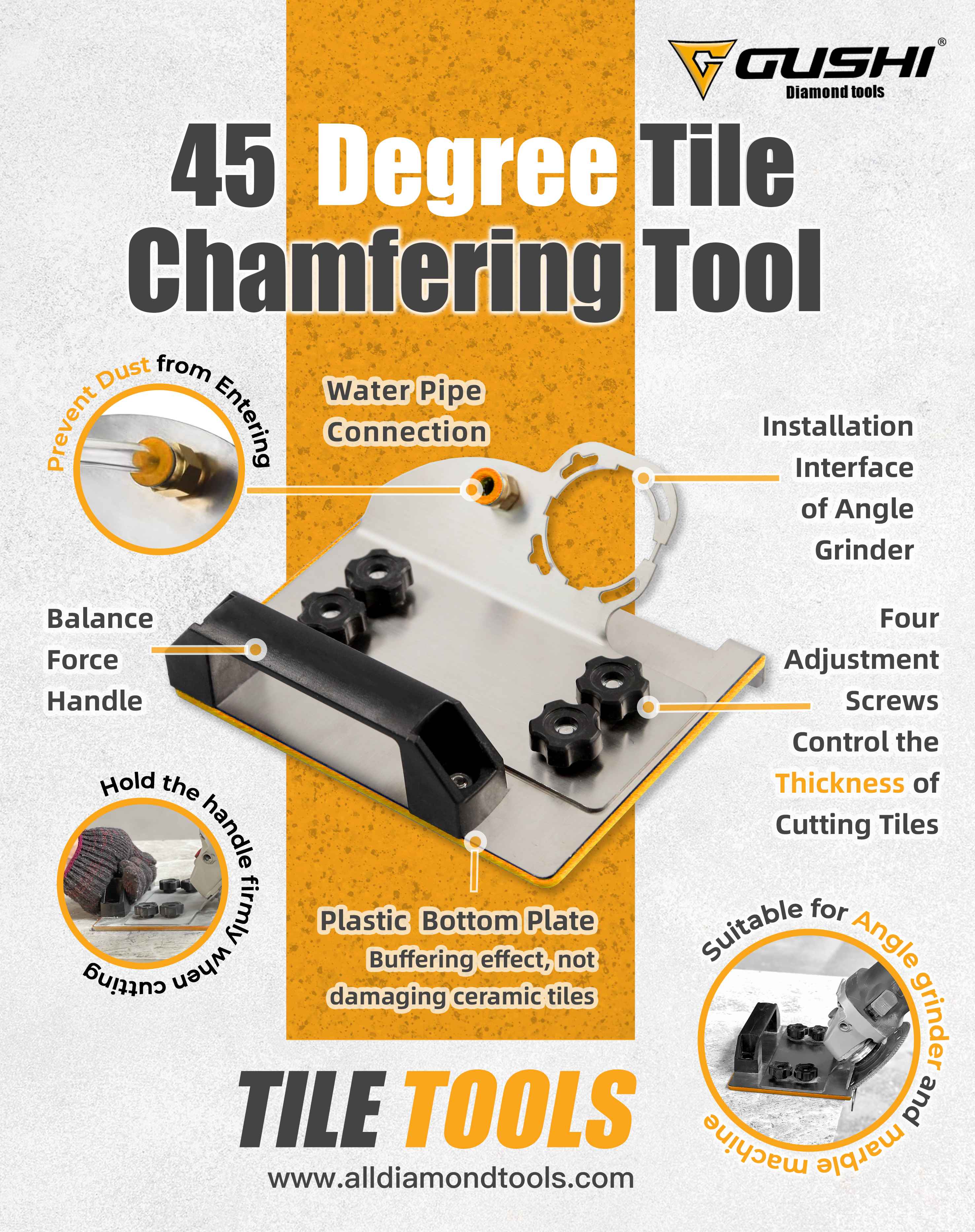
What it is for
Straight 45° bevels on ceramic, marble, and stone tile edges — the kind you need on open (external) corners where two tiles meet at a right angle.
Matching a tile edge to a stone or wood profile without a separate profiling bit.
Repeat runs: once the jig is set, the tenth tile leaves the same bevel as the first. Freehand, the tenth is usually where it starts to drift.

How it is built
The body is aluminium alloy. That is the point — light enough to carry to site, rigid enough to hold the angle under the grinder's vibration. It is a positioning tool, not a cutter, so nothing here wears from touching the tile.

How to cut with it
Set the jig on a flat, steady surface. The tile rests against the fence.
Make the first cut on a scrap piece. A 45° bevel looks different from a straight cut, and it is worth seeing it before you commit to a visible edge.
One steady pass. Stopping halfway pools heat on one spot and the edge can chip — the same as freehand cutting.
Do not force it. The grinder and blade do the work; the jig just holds the line.
What it does not do
It is not a cutter. No blade, no bevel. Pair it with a continuous-rim or turbo diamond blade.
It does not polish. The bevel comes out matte from the diamond blade; a polished edge needs a separate polishing step.
It is for straight edges only. Curved or shaped profiles need a different tool.
Bevel quality tracks the blade you fit, not the jig. A worn or wrong blade gives a poor bevel no matter how true the angle is held.
Aluminium alloy is light but soft. Do not drop it on steel or use it as a hammer — the fence face is what keeps the angle straight.

FAQ
Does it fit any angle grinder?
It clamps to a standard grinder; check the collar size against your model.
Can it cut curves?
No. It holds a straight 45° line. Curves need a different setup.
Which blade should I use?
Continuous-rim for clean porcelain/ceramic bevels; turbo or segmented for marble/stone where speed matters more than edge finish.
Will the bevel be polished?
No. The diamond blade leaves a matte edge. Polishing is a separate step.
Why not just hold the grinder by hand?
You can, on the first tile. By the fifth or tenth the angle drifts and the corner will not close. The jig keeps it identical.