SDS-Plus Hammer Drill Bit: How to Spec It for Your Market
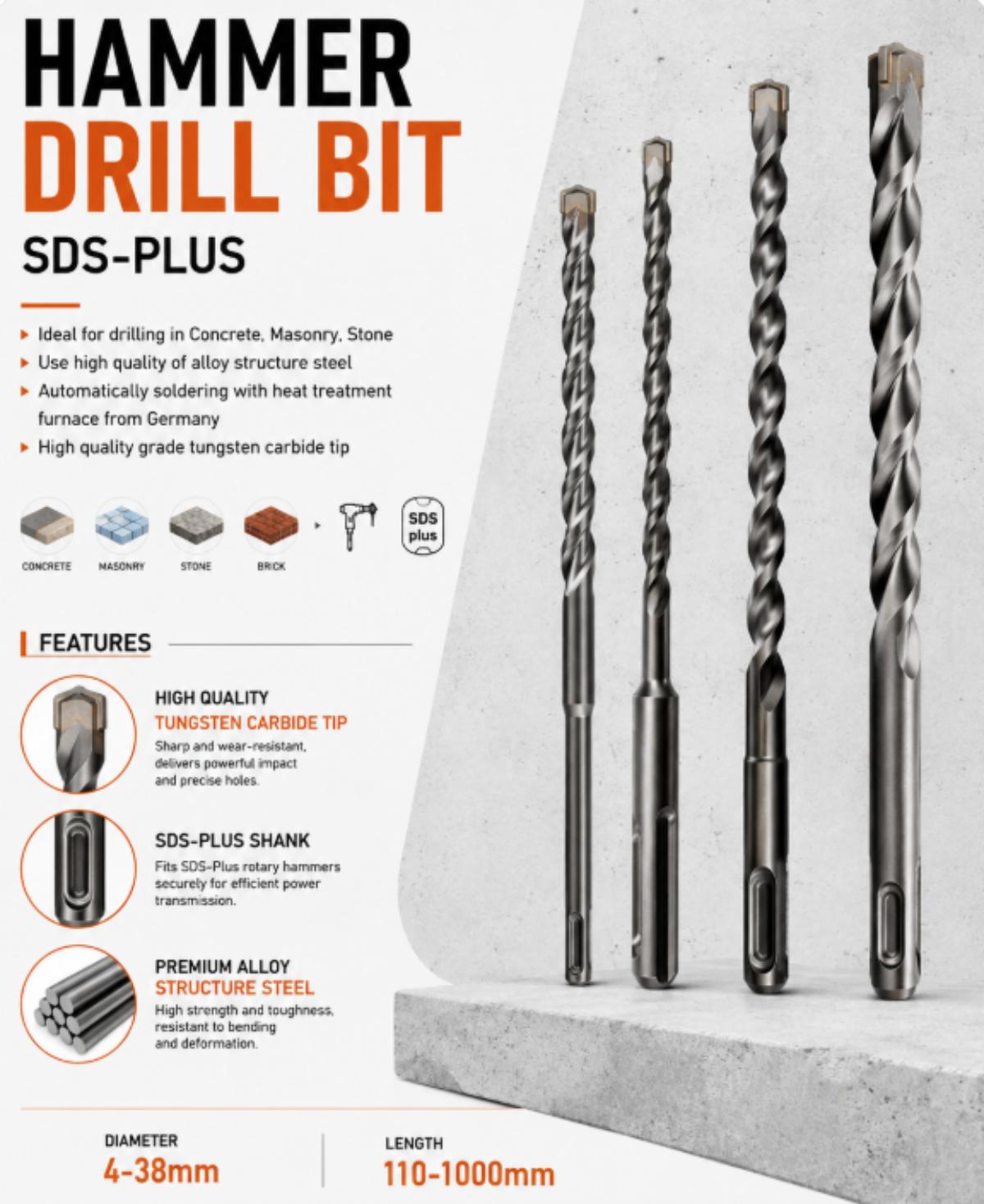
An SDS-Plus hammer drill bit goes into a light or medium rotary hammer. Not into a keyed chuck, and not into a hammer that takes SDS-Max. It has a 10 mm shank with two open and two closed grooves, a brazed tungsten carbide tip, and it makes holes in concrete, brick, block and stone by crushing the material instead of cutting it. Below: the sizes we run, how to pick a tip geometry, and the jobs where selling this bit would be a mistake.
How the bit removes material
Concrete is not cut. The tip strikes it, the impact breaks a small cone of material under the edge, and the flutes carry the debris out while the bit rotates. Almost everything that goes wrong with these bits comes back to those two facts.
The tip does the work, not an edge. Once it dulls or chips, it stops breaking concrete and starts rubbing it, and rubbing is heat.
And the dust has to leave the hole. Pack the flutes and the tip grinds in its own powder; the braze behind it cooks, then lets go. That is the usual death of an SDS-Plus bit. It does not happen in a factory. It happens when someone drills a deep hole in old hard concrete and leans on the tool.
Shank, chuck and what actually limits the bit
The SDS-Plus shank measures 10 mm across. Two open grooves drive the rotation, two closed grooves stop the bit from dropping out. It sits in the chuck with a few millimetres of axial float, and that float is deliberate — it lets the hammer strike without the bit being pre-loaded against the bottom of the hole.
That is also why a three-jaw chuck is the wrong home for it. A keyed chuck holds by friction, impact vibration walks the bit loose, and the shank gets polished until it spins. When a customer reports a bit turning in the chuck, the bit is usually fine and the tool is wrong.
Above SDS-Plus sits SDS-Max, on a much heavier shank, for demolition-class breakers. The two do not interchange, and forcing it is how shanks snap. Our SDS-Max range is on a separate page for that reason.
What limits an SDS-Plus bit is the class of hammer, not a number stamped on the shank. At the small end, a 4 or 5 mm bit in a light rotary hammer is quick work. At 38 mm you are at the top of what a light hammer wants to push: expect slow progress and a hot tip, and step up to a core bit if the hole matters.
Technique that keeps the tip alive
Wrap a piece of tape on the bit at the depth you want before you start. It sounds trivial. It is the difference between a 60 mm anchor hole and a 75 mm one that has to be re-drilled.
Start slowly until the tip seats. On smooth formed concrete a fast start walks the bit across the surface, and the customer blames the bit for a hole in the wrong place.
Then pull out and clear. When you feel the feed slow down, come out, let the flutes dump their load, and go back in. Deep holes and hard aggregate are where that habit pays.
If it stops dead, you hit rebar. Don't lean on it, move the hole. A tip that chips on rebar at an angle is not a warranty case. It is the cost of drilling blind.
Long bits need patience. A 1000 mm bit flexes, so keep it straight, drill in stages, and never use the bit as a lever to open a hole up. That bends the shank, and it never runs true again.
Dust, water and the part nobody warns about
These bits drill dry. Do not pour water down the hole to cool one off. A hot carbide tip meeting cold water is thermal shock, and either the tip cracks or the braze lets go.
Use extraction where you can, or at least a vacuum at the hole mouth. Concrete dust carries crystalline silica, which is why crews wear P2 or P3 respirators for overhead and indoor work. Goggles for the chips that come back out, ear protection if the hammer runs all day. None of that sells bits. But a distributor who mentions it gets treated like a supplier rather than a catalogue.
What kills these bits early
Heat at the tip. A dull tip plus body weight is the fastest route to a lost tip, and it comes back looking like a manufacturing fault.
A strike on rebar at an angle. Carbide is hard, not tough. It chips.
Levering a hole wider. The shank bends by a few tenths of a millimetre and the bit wobbles from then on.
Packed flutes, usually green concrete, wet conditions, or a deep hole drilled without clearing.
Grit in the chuck. The grooves wear, the bit slips, and it happens long before the tip is finished.
Frequently asked
Will it fit my hammer?
Only if the hammer has an SDS-Plus chuck. If the shank is thicker and the grooves are wider, the tool takes SDS-Max and this bit will not go in.
Cross head or straight head —
which should I stock?Cross head has four cutting edges and centres itself better on rough or uneven concrete, so it is the safer default. Straight head is the simpler, cheaper geometry and it is fine in soft brick and block. Most importers carry both and let the price point decide.
Can I use it in a normal drill chuck?
No. A three-jaw chuck cannot hold the shank under impact; the bit walks loose and the shank gets polished. It is also a genuine safety problem, not just a wear one.
What happens if I hit rebar?
Progress stops and the tip takes a hit it was not designed for. Back out, move the hole a few centimetres, and start again. Forcing it through is how you lose a tip and possibly a bit of temper in the steel.
Can you make it under our brand?
Yes. Diameter, length, tip geometry, carbide grade, surface finish and packing are all settable, and we run OEM programmes with artwork on the shank and your own card or box. Send the size list you sell and we will quote against it.