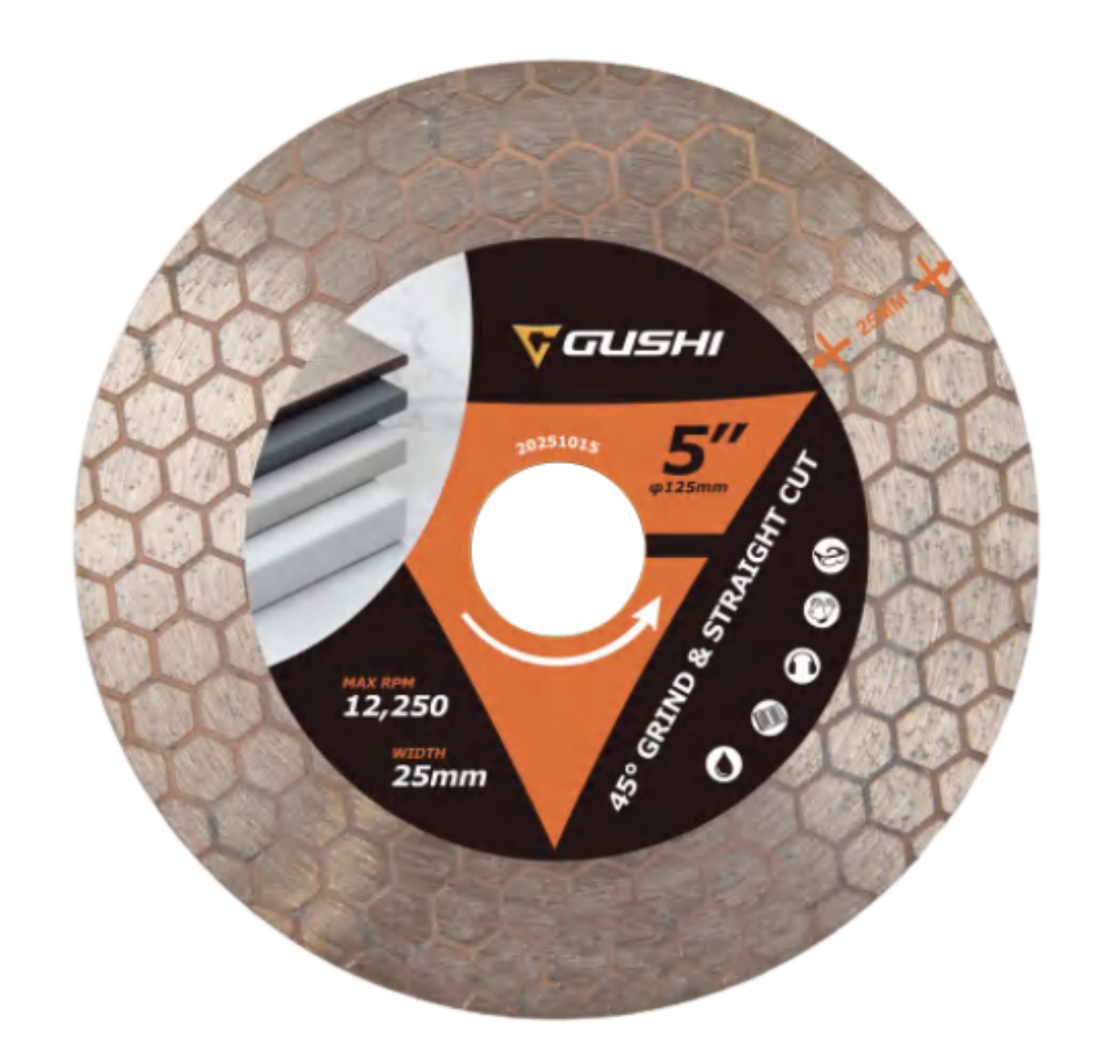
Honeycomb Diamond Blade 125mm — 45° Grind & Straight Cut \| GUSHI
GUSHI's 125 mm honeycomb diamond blade does two jobs in one pass: the rim makes the straight cut, and the 25 mm diamond band on the side dresses a 45° bevel. Max 12,250 rpm. It is a tile and stone blade — not a steel blade.
What it cuts
Large-format porcelain is the fastest-moving part of the tile market, and on large formats the visible edge is the whole job. That is where a 45° bevel earns its money.
Porcelain and ceramic tile — wall and floor, glazed and full-body.
Granite, marble, quartz and engineered stone.
Terrazzo.
Straight cuts, 45° mitres and edge dressing with the same blade.
What it does not cut. Steel, rebar, aluminium and wood are out. Diamond on steel loads and burns within minutes — for metal and masonry use the 125 mm multi-purpose blade. Glass needs a different bond and a different edge; use the glass blade. And this is not a polishing tool: it dresses a bevel flat and clean, it does not bring it to a mirror — that last step is a resin pad.
Mounting and speed
12,250 rpm max, printed on the label. Check the grinder's no-load speed on the nameplate; it must not exceed the blade's maximum. A 125 mm grinder rated 11,000–12,000 rpm is the normal match.
Mount with the arrow in the direction of rotation. Flanges clean and flat, nut tightened with the wrench — not by hand.
Run 60 seconds at full speed, away from the work, before the first cut. Listen for wobble.
The label carries four PPE icons and a water drop: face shield, ear protection, respirator, gloves — and wet cutting is allowed. Wear all four. The drop is not decoration.
How to cut a 45° bevel that closes
The rim cuts the tile; the 25 mm side band does the bevel. That band is radial width, not kerf thickness — it is the number that decides whether you finish the bevel without turning the blade around.
On a 10 mm tile, the 45° face measures about 14 mm across (10 ÷ cos45°). A 25 mm band covers it with room to spare, so you are not grinding on the last two millimetres.
The angle comes from a fixture or a steady hand against a straight edge. The blade does not set the angle — if you need repeatable mitres, use a 45° chamfer jig.
One continuous pass. Stopping halfway leaves the heat in one spot and shows as a step or a chip when you re-enter.
Keep the blade square to the cut face. Tilting it sideways wears one edge of the band and puts a wave in the bevel.
Leave about 1 mm flat at the root of the bevel. A bevel ground to a knife edge has no support behind it and chips on the first bump.
Wet or dry, and dust
The water-drop icon says wet is allowed. On porcelain, quartz and engineered stone, run wet: water keeps the band from glazing and carries slurry out of the honeycomb cells.
Dry is fine on ceramic wall tile and short runs. It is not fine on granite or quartz in a closed room.
Cutting tile and stone generates respirable crystalline silica. Wet cutting is the cheapest control. If you cut dry, use an FFP3 / N95 respirator and extraction. A paper mask is not a silica respirator.
What shortens the life of the band
Running above 12,250 rpm. Over-speed is what throws a blade, and it burns the bond as well.
Twisting in the kerf to "steer" the cut. The band takes the load on one edge and wears a groove.
Cutting steel, rebar or aluminium. The diamond loads, the cut stops, the operator pushes harder, the band overheats.
Dry-cutting granite or quartz for long runs. Heat glazes the bond and the blade stops biting.
Dropping it. A 125 mm blade that has been dropped on a bench is worth checking for a bent flange before it goes back on the grinder.
Worn or dirty flanges. A burr on the flange puts a wobble in the blade that no operator can cut straight through.
Frequently asked
Is this the same as a continuous rim blade?
No. A continuous rim has a solid cutting edge. This one has a 25 mm diamond band on the side and hexagonal cells; the rim cuts, the band dresses the 45° bevel. For plain straight cutting on tile, a continuous rim blade is the cheaper tool.
Can it cut a 45° bevel in one pass?
On 6–12 mm tile, yes, if you keep the pass steady. On thick stone or a full bullnose, take a second light pass.
Will it fit a standard 125 mm angle grinder?
Yes, if the grinder's no-load speed is at or below 12,250 rpm and the arbor matches. Confirm the bore before ordering.
Can I use it on steel?
No. Diamond loads on steel. Use the multi-purpose blade.
Can I use it wet?
Yes — the water-drop icon marks it for wet use. Wet is better on porcelain, quartz and engineered stone.