Super Thin Diamond Blades: A Wholesale Buyer's Guide
Short answer. A super thin blade is a good line to carry, as long as you also teach your customers what it will not survive. The blade itself is not the problem — the problem is that a 1.1 mm core gets sold into a job that wanted a 2 mm one, and comes back as a complaint about "bad quality" when it was really a bad match.
What the thin kerf actually buys your customer
Kerf is the width of the cut. Take material out of the kerf and you are removing less stone on every pass, which shows up in three places: less slurry to deal with, less resistance pushing back at the operator, and less chipping on the exit edge of a fragile tile. On a small grinder it also draws less, which matters when the grinder is a 900 W model running off a long extension lead.
That is the honest case for the product, and it is enough. You do not need to promise a percentage of material saved. Anyone who quotes you one is quoting his best case on his material.
Put the thickness next to the diameter, always
This is where most thin-blade catalogues fall apart. A kerf number on its own means nothing; it only means something attached to a diameter.
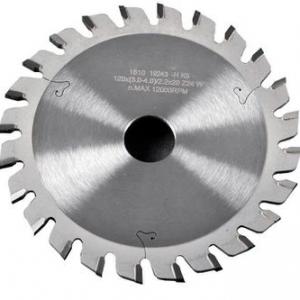
For our own thin turbo series, the two sizes that carry a 1.1 mm kerf are 115 mm and 125 mm. Both use a 9 mm segment height and a 22.23 mm arbor, and they are rated 13,300 rpm and 12,500 rpm respectively. Those are the numbers we put on a box.
If a supplier's catalogue lists "1.1 mm" and "230 mm" in the same breath, ask which diameter that thickness belongs to. A 230 mm blade needs more core than that to stay straight under load. We would rather tell you that than print a number that comes back as a return.
Where thin blades fail, and why it is usually not the blade
Three things kill these discs, and none of them happen in our factory.
The first is a dirty flange. A chip of dried slurry, a burr, a bit of grit under the flange tilts the blade. A 2 mm core will forgive that for a while. A 1.1 mm core will not — it will run out of true, then crack from the arbor outward, and it will do it on the third or fourth cut, not the first, so nobody connects the two.
The second is side load. Somebody uses the blade to widen a cut, or cuts a curve, or plunges at an angle because the tile is already fixed. Thin cores have no material to spare for that. If the job needs any of it, it needs a standard kerf.
The third is spindle condition. A worn bearing or a bent arbor shows up first on the thinnest blade in the van. The operator blames the blade; the runout was there before.
Dry or wet, and what to print on the label
This series cuts both ways, and that is genuinely useful for tile work where water is a nuisance. But be precise on the label: "dry and wet" is a statement about the blade, not a licence to dry-cut everything. Water on a 1.1 mm disc does more than control dust. It keeps the core cool, and a cool core stays straight. On long runs, even a light water feed is worth more than a faster pass.
If a customer is cutting dry all day on porcelain, ask him how hot the blade gets. Not to sell him water — to know whether the next complaint is coming.
Who to sell it to, and who to refuse
Sell it to tile contractors, stone fabricators doing slab trim and edge work, mosaic and large-format installers, and shops cutting porcelain, ceramic, marble, granite and quartz.
Do not sell it into concrete cutting, demolition, rebar, block and brick restoration, or any job where the blade will be leaned on. Those customers are not bad customers; they are the wrong product, and they will destroy a thin blade in an afternoon and tell everyone it was soft.
For those jobs, keep a segmented or standard turbo blade in the assortment. A distributor who stocks both sells more, not less, because he stops losing the concrete customer to the next shop.
What to fix in an OEM order
Six things decide whether a container of thin blades sells or sits. The diameter and the kerf it is quoted against. The segment height, which sets how much life is in the blade before it stops cutting. The arbor — 22.23 mm covers most of Europe and the Middle East, but confirm for your market. Silent or standard core, since some markets ask for the quiet version on site. The flange print: your logo, and whether you want the rpm, the size and the safety icons on it. And the packaging, because a thin blade in a flimsy sleeve arrives in pieces.
Minimum order, lead time and packaging options we quote per order — ask, and we will put the numbers against your sizes rather than a generic table.
Frequently asked
Is 1.1 mm too fragile for a building site?
For tile and slab work with a true flange and a straight cut, no. For site work where the blade gets leaned on and knocked about, yes — use a standard kerf and stop worrying about the last half millimetre.
Can one blade cut both porcelain and marble?
In this series, yes. Hard porcelain wears the rim faster than marble does, so the same blade will last longer in a marble shop than in a porcelain shop. Sell the assortment by material mix, not by one blade for everything.
Why does my customer's blade crack from the arbor outward?
Almost always mounting: grit or a burr under the flange, or a flange that is not flat. It is rarely the segment. Ask for a photo of the flange before you replace anything.
Do you offer a silent core?
Yes, silent and standard core options are available for this series. Tell us which one your market asks for when you order.
Can you print our brand on the blade and the box?
Yes — flange print, box artwork and language versions. Send the artwork and the sizes you want, and we will come back with the minimum quantity for that combination.