GUSHI Multi Purpose Blade 125 mm Vacuum Brazed
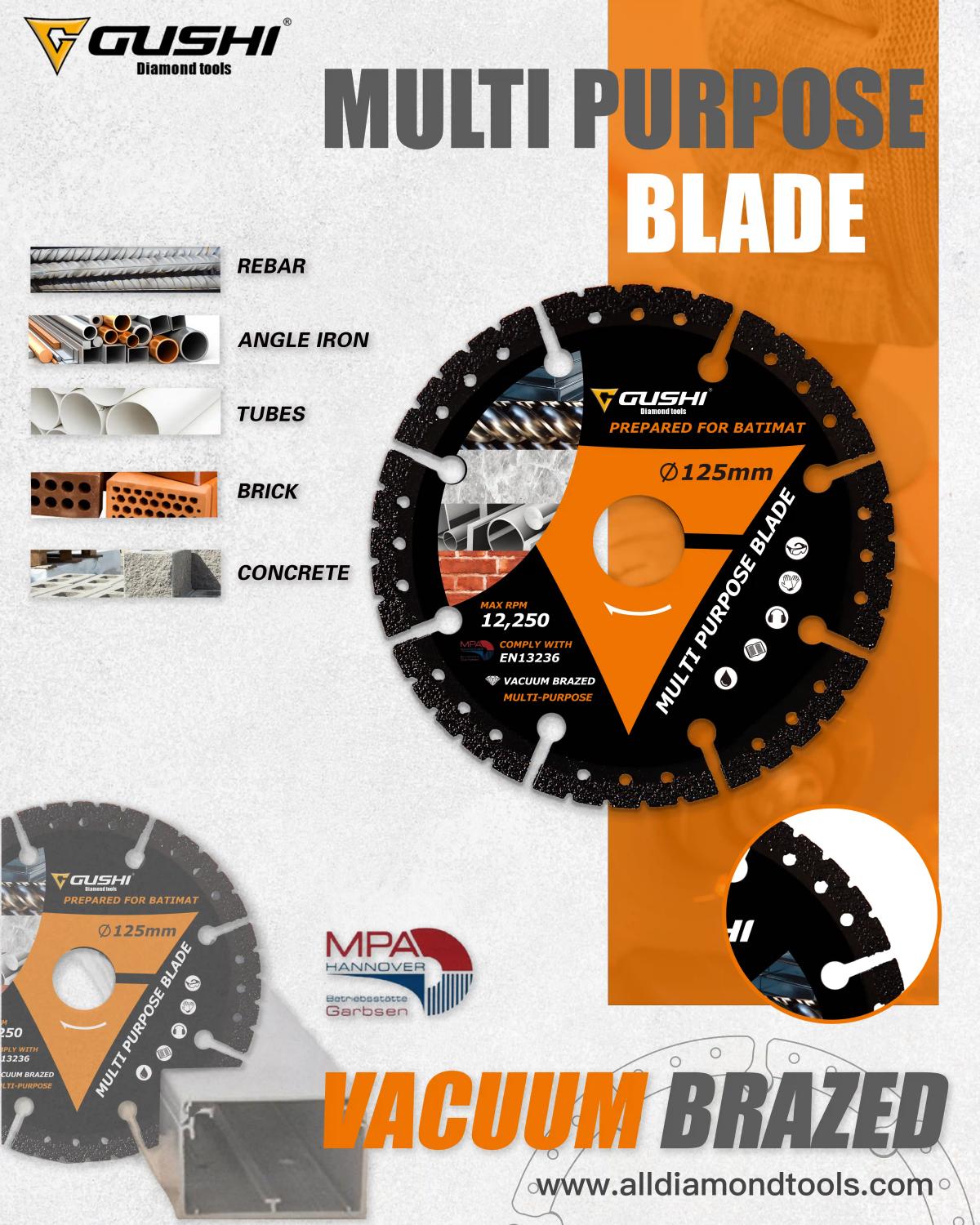
Short answer. A 125 mm vacuum brazed blade for a 125 mm angle grinder. It cuts rebar, angle iron, tubes, brick and concrete — same disc, five materials. Max 12,250 rpm, marked to EN 13236.
What it cuts
The five materials printed on the disc:
Rebar — cut to length on site, and mesh
Angle iron — angle iron, flat bar, thin profiles
Tubes — round and square, thin wall
Brick — solid and hollow
Concrete — thin slabs, lintels, edging
This is the disc that stays on the grinder when the job is mixed. A bit of rebar, a length of tube, two bricks to trim. Changing blades five times before lunch is the part it takes away.
What it does not cut. Tiles, porcelain, marble and engineered stone need a different blade — a thin continuous rim, or they chip on the face. Wood and laminate are another blade again. And this is not a grinding disc: no work on the side of the rim. If your day is mostly tile, look at the Super Thin Turbo Diamond Blade; if it is mostly wood, the WoodPlus 125 mm multi-material disc is the sister product.
Mounting, speed, and what the markings mean
Mount it on a 125 mm angle grinder.
12,250 rpm is the ceiling. That number is printed on the disc, and it is not decoration. A 180 mm or 230 mm grinder spins faster than that, so this disc does not go on one. Overspeed is how blades come apart.
Match the direction arrow. The arrow is on the disc face; the grinder's rotation has to follow it.
EN 13236 is why the disc carries all that print. The standard requires ten items on a superabrasive cutting wheel: usage restrictions, maximum working speed, direction of rotation, dimensions, declaration of conformity, manufacturer or brand, supplier, maximum rpm, a traceability code, and PPE pictograms. So the
Ø125mm, the12,250, the arrow, theEN13236line and the GUSHI name are all part of the same compliance marking. On a disc with none of it, you have no way to tell what you are holding.PPE is not optional on brick and concrete. Glasses or a face shield, hearing protection, gloves, and a respirator. Cut concrete and brick long enough and you are breathing quartz dust. Keep the guard on.
How to cut with it
Let the diamond do the cutting. Push harder and you do not cut faster — you load the segment and raise the temperature.
Go in straight. No twisting the disc inside the cut. If it starts to bind, back off and check that the workpiece is not pinching it closed.
Take deep concrete in passes. Do not try to bury the disc in one push. Two or three shallower passes cut faster than one forced one, and the disc stays cooler.
Support the cut-off end so it falls free. Rebar that is held at both ends and cut in the middle closes on the blade and grabs it.
On rebar, expect the edge to work. Cutting through steel with a diamond rim is abrasive work — the disc does it, but it is what wears the segment.
Dust, and whether to run it wet
Dry cutting is normal for this disc in steel and tube work. On brick and concrete the problem is not the disc, it is the air.
Quartz dust from concrete and brick causes silicosis, and silicosis does not reverse. If you are cutting indoors or in a courtyard, extract the dust or wear FFP2/FFP3. If water is available and the job allows it, wet cutting keeps the dust down and the segment cooler — but check the label that ships with your order before you run this disc wet, because the print on the disc does not state whether this version is rated for it. For high-volume concrete cutting, a concrete and asphalt blade is the better tool; the dry-cutting range is here.
What shortens the life of the disc
Grinding on the side of the rim. The brazed layer is on the perimeter for a reason. Side load is the fastest way to lose it.
Fitting it to a 180 or 230 mm grinder. Higher rpm, more heat, more risk.
Long continuous cuts in concrete with no break. Let it cool between passes.
Forcing a jammed cut. That is how the disc cracks.
Materials not on the list. Steel cable, cast iron, thick stainless: the diamond edge disappears quickly on these. Bring the right product instead of a second disc.
FAQ
1. Can one disc really cut rebar and concrete without being mediocre at both?
It can cut both, and it is not the fastest way to cut either. If you cut rebar all day, a dedicated metal blade will outlast it. If you pour and cut concrete slabs all day, a concrete blade is faster. This one earns its place on mixed jobs and in a van where you carry one grinder.
2. How is vacuum brazed different from the sintered blades I usually buy?
Brazing fixes the diamond directly onto the steel rim instead of sintering it inside a metal matrix. There is no matrix to wear away first, so the abrasive starts working from the first touch. The trade-off is that the rim is thinner in service life than a deep sintered segment on homogeneous material.
3. Do I need water when cutting brick and concrete?
For your lungs, yes, something has to control the dust — water or extraction. Whether this specific disc is rated for wet cutting depends on your order's label, see the note above.
4. Can I use the side of the disc to grind?
No. Cut only. Side grinding destroys the brazed layer and it is the single most common way this type of disc dies early.
5. Will it cut wood, aluminium or PVC?
Wood is not its job — the WoodPlus disc handles that. Aluminium and PVC will cut, but they load the rim with soft material and you will notice the disc cutting slower afterwards.