Diamond Blade for Glass and Porcelain, 115 mm Vacuum Brazed | GUSHI
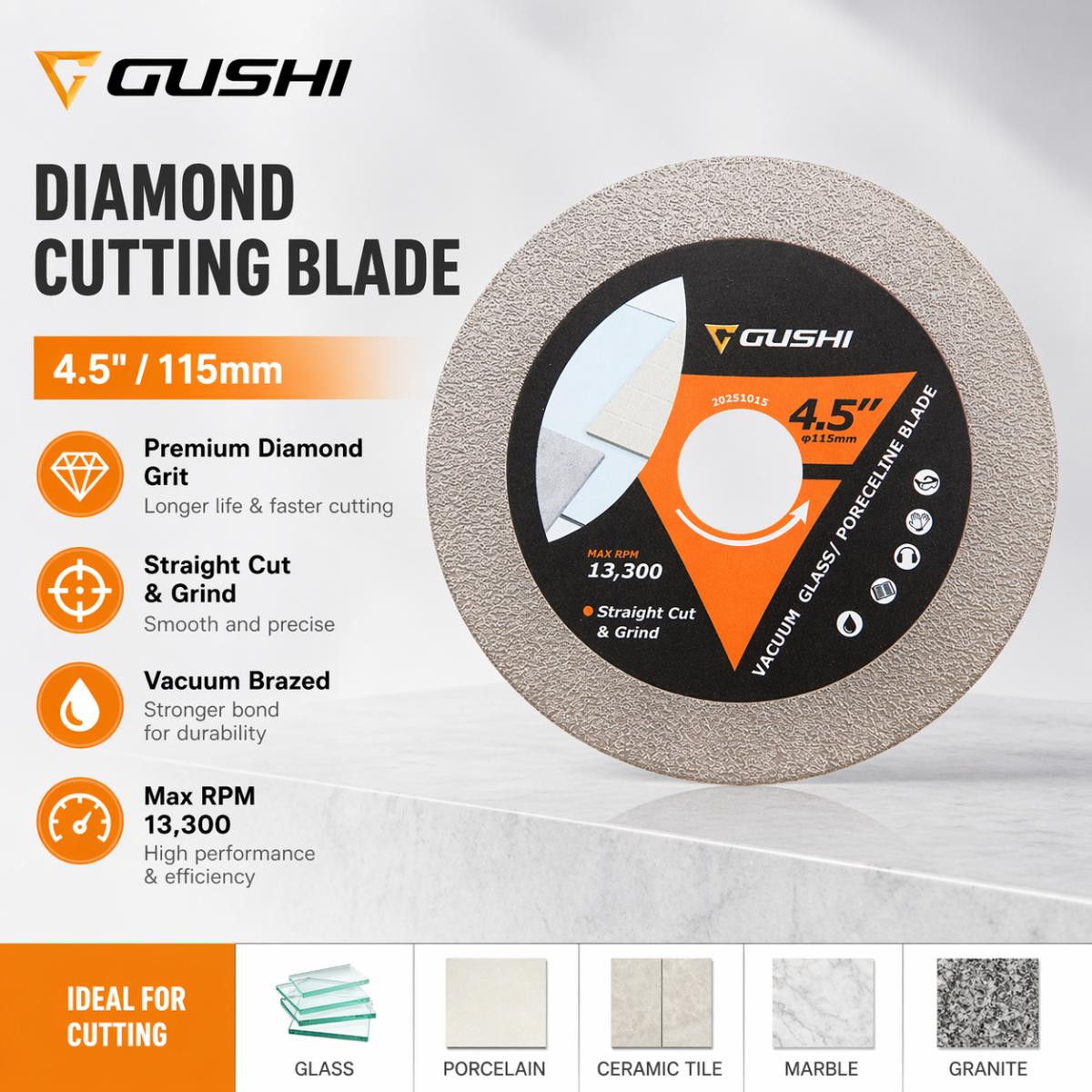
Short answer. A 115 mm (4.5") vacuum brazed diamond blade for a 4.5-inch angle grinder. It cuts glass, porcelain, ceramic tile, marble and granite, and the same disc grinds the cut edge. Maximum 13,300 rpm.
What it cuts
Five materials, printed on the disc itself:
Glass — flat glass, shelves, mirror stock
Porcelain — hard porcelain and porcelain tile
Ceramic tile — glazed wall and floor tile
Marble — including the soft, veined grades
Granite
What it does not cut
Metal. Steel, rebar, angle iron, tubes — that is the work of our 125 mm multi-material disc, not this one. Multi Purpose Blade 125 mm
Wood, laminate, plasterboard. Different rim, different speed. We make a disc for that. WoodPlus 125 mm disc
Sintered and ultra-compact stone. Harder than granite. A turbo blade cuts those better. Super thin turbo blade
Holes. This is a blade, not a bit. A hole through glass is a drilling job. Glass drill bit
It leaves a cut, not a mirror. For a polished edge you still finish with pads.
Mounting and speed
Fit it to a 115 mm (4.5-inch) angle grinder. The disc carries Ø115 mm and MAX RPM 13,300 stamped on the steel. That 13,300 is a ceiling, not a target — check the no-load speed on your grinder's own label, and as long as it sits under 13,300 you are in spec. Do not run a disc on a machine it was not sized for.
The rest of the print is safety marking, not decoration. There is a rotation arrow — fit the disc so the arrow matches the spindle direction. And there are pictograms: eye and face, hearing, hands, and a water drop.
If you sell into Europe and need the EN 13236 conformity paperwork for this item, say so when you enquire.
How to cut glass with it
Let the rim cut. Push and you crack the glass; ease off and the diamond does the work.
One steady pass. Stopping halfway on glass parks the heat in one spot, and that is where a chip starts.
Support the sheet flat, right up to the line. Glass flexes over a gap and breaks over a gap.
Keep the blade square to the cut. Angling the disc loads one shoulder of the rim and wears it uneven.
Tape the line on tile and porcelain, and cut glaze side down where you can. Cheaper than a chipped edge.
Water and dust
The disc is marked for wet cutting, and on glass and porcelain that is not really optional. Water cools the rim, flushes the swarf out of the kerf, and holds off the heat that chips a glaze or crazes glass. It is also the cheapest dust control there is.
Tile, marble and granite throw respirable silica when you cut them dry. That is the dust that scars lungs. Keep it wet. If you cut dry anyway, wear an FFP3 mask and run extraction.
What shortens its life
Levering the disc sideways to hurry a cut.
Running porcelain or glass dry until the rim is too hot to touch.
Using the flat face like a grinding wheel instead of the edge.
Cutting metal with it. That strips the brazed layer off.
Clogging the rim on soft, sticky material.
Dropping it, or bending the core. A warped core never cuts straight again.
Common questions
Will it chip the glass?
With water and a steady feed, no more than you would expect from any diamond cut. Chips come from heat and from forcing — both are avoidable.
Dry or wet?
Wet. The water drop on the disc is there for a reason: on glass and porcelain it is the difference between a clean edge and a spoiled one.
Which grinder does it fit?
A 115 mm (4.5-inch) angle grinder. The disc is rated to 13,300 rpm; keep your machine under that.
Can it cut metal or wood?
No. Metal chews the brazed layer off, and wood loads the rim. We make separate discs for both — links are above.
Does it carry EN 13236?
The disc as shown carries its max rpm, direction arrow and PPE pictograms. For the EN 13236 conformity declaration for your market, ask us and we will tell you exactly what is available for this item.