Continuous Rim Tile Blade 115/125 mm, 45° Edge Grinding | GUSHI
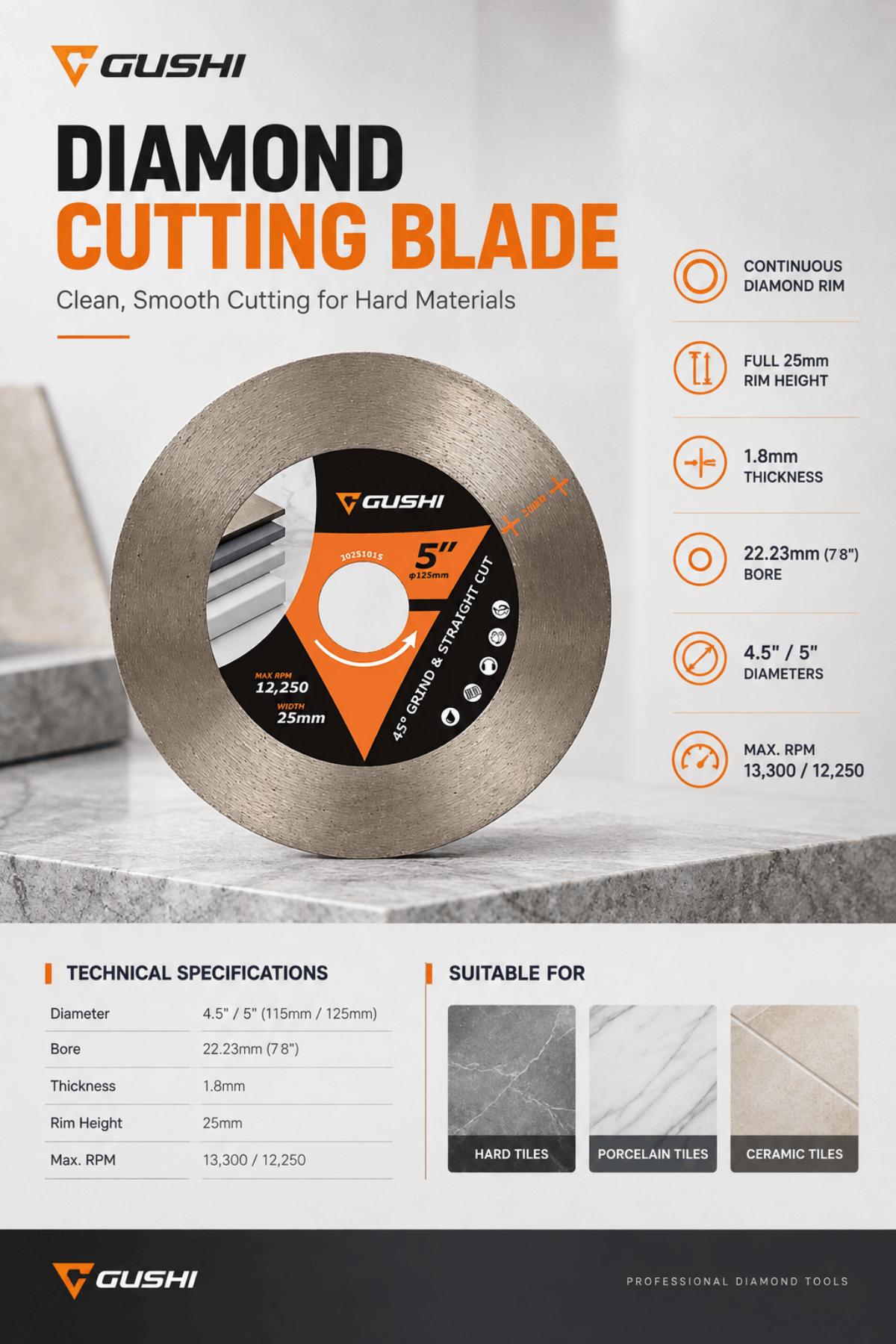
Short answer. A continuous rim diamond blade in 115 mm (4.5") and 125 mm (5") for a small angle grinder. It cuts hard tile, porcelain tile and ceramic tile, and the same disc grinds a 45° bevel along a tile edge. Maximum 13,300 rpm on the 115, 12,250 rpm on the 125.
What it cuts
Three materials, marked on the blade:
Hard tiles — the dense porcelain grades. The ones that flatten a cheap blade inside a metre of cutting.
Porcelain tiles — including rectified sheets and the larger formats. On a big sheet, tilers cut a little oversize with this disc and then dress the last millimetre off the edge with the rim, because the edge you grind is under your control and the edge you snap is not.
Ceramic tiles — glazed wall and floor tile, and the thin brittle bodies that chip the moment you push them.
What it does not cut
Metal. Steel, rebar, angle iron, tube — a completely different disc. Multi Purpose Blade 125 mm
Wood, laminate, plasterboard. Fine diamond packed into a closed rim clogs and burns on wood. Wrong blade. WoodPlus 125 mm disc
Ultra-compact and sintered surfaces. Dekton and its relatives are harder than granite; they want a turbo blade. Dekton turbo diamond blade
Flat glass, mirror, shelves. Nothing on this disc's sheet covers glass. Glass is a separate blade in our range. Glass and porcelain blade 115 mm
Holes. This is a blade, not a bit. A hole through hard tile is a drilling job. Hard ceramic drill bits
And one honest limit: it cuts and it grinds, but it does not polish. A 45° bevel comes off this disc grey and matte. If the joint has to read like a factory edge, the last step is a polishing pad, not this disc.
Mounting and speed
The bore is 22.23 mm (7/8") — the standard fitting for a small hand grinder, so it goes straight onto the spindle. The 115 mm disc belongs on a 4.5-inch machine, the 125 mm on a 5-inch.
The marked ceiling is 13,300 rpm on the 115 and 12,250 on the 125. That figure is a ceiling, not a target. Read the no-load speed off the label on your own grinder: as long as it sits under the disc's number, you are inside spec. Running a disc over its marked speed is how cores bend.
The rest of the print matters too. There is a rotation arrow, so fit the disc with the arrow running the way the spindle turns. There are pictograms for eye and face, hearing and hands. There is a lot code stamped on the steel — keep it, it is the number you quote if a run ever has to be traced back.
There is no water-drop symbol on this disc. Whether it is cleared for wet cutting is confirmed against the order, so ask when you enquire. Do not assume it from the blade's neighbours in the catalogue.
Thickness is 1.8 mm. That thin kerf takes less material out of the tile, draws less power from the grinder, and leaves less edge to clean up afterwards. It also means there is no spare stiffness in the plate, so never lever the disc sideways to hurry a cut.
Two jobs on one disc
The disc is marked 45° GRINDING & STRAIGHT CUT. The straight cut is obvious. The second job is the interesting one.
An outside corner on a tiled wall can be closed two ways. The quick way is a trim strip. The good way is to take 45° off the back of each tile edge so the two tiles meet in a corner with no strip visible at all. Estate agents call it a detail. Setters call it work, and on large-format porcelain it is now the default — a strip in the middle of a 1200 × 2400 sheet looks like an apology.
That is a job that needs diamond on the side of the rim, not just the tip, and it is why this disc carries a full 25 mm rim. Do the arithmetic and it makes sense: a 45° bevel on a 10 mm tile measures roughly 14 mm across the face. A short rim runs out of diamond halfway down and you end up going back over the same edge, which is exactly how a bevel turns into a wave. Twenty-five millimetres of diamond reaches the whole bevel in one pass.
One thing to be clear about: the disc does not set the angle. Your hand sets it, or a guide does. Freehand gets you close on the first tile and drifts by the tenth, which on a visible corner is a callback. If you are running a bevel across a whole room, hold the grinder in a fixed guide. 45 degree angle chamfer guide
Worth knowing too: most setters stop the grind about a millimetre short and leave a small flat at the back of the joint. A bevel taken all the way to a knife edge has nothing behind it, and the first thing it meets is a trolley wheel.
How to cut tile without chipping it
Let the rim cut. Pressure does not cut tile faster. It loads the spindle, heats the rim and buys you nothing.
One steady pass. Stop halfway and the heat parks in one spot. That spot is where the chip starts.
Support the sheet flat, right up to the line. Porcelain breaks over a gap, not along a score.
Keep the disc square to the face. A 1.8 mm plate angled off-axis loads one shoulder of the rim and wears it lopsided.
Cut glaze side down where you can, and tape the line on glazed tile. Glaze chips before the body does.
Cut oversize, then finish. On anything expensive, cut 1–2 mm proud of the line and take the last bit with the side of the rim.
Let the disc reach full speed before the rim touches the tile.
Do not steer it. This is a straight blade. Curves, arcs and corners are a different tool.
Water and dust
Tile, porcelain and ceramic all throw respirable crystalline silica when they are cut dry — the fine fraction that scars lungs. It is not the dust you can see settling on the floor; it is the part that stays in the air. Keep the cut wet wherever the disc is cleared for it. If you cut dry anyway, wear an FFP3 mask and put extraction right at the cut, not across the room.
Water does a second job. It cools the rim and flushes the swarf out of the kerf, and a rim that runs cool keeps its diamonds longer. Running hard porcelain dry until the rim is too hot to touch is the fastest way to turn a cutting disc into a rubbing disc.
Then clean up. Tile dust on the floor is abrasive, and once it is walked in it scratches the tile you just laid.
What shortens its life
Tipping the disc over to speed a cut, or levering it in the kerf.
Cutting metal with it. That will strip the diamond band off.
Running it through soft, sticky material — packed mud, thick adhesive. It fills the rim and glazes it over.
Cutting hard porcelain dry until the rim is hot enough to burn your hand.
Grinding a full 45° bevel on tile after tile. The edge grind wears the side of the band far faster than a straight cut does; budget blades for it.
Dropping it, or bending the core. A warped core never cuts a straight line again, and it will not be obvious until you are halfway through a sheet.
Running it above the marked rpm.
Frequently asked questions
Will it fit my grinder?
The bore is 22.23 mm (7/8"), which is the standard small-grinder spindle fitting. Match the disc to the machine: 115 mm on a 4.5-inch grinder, 125 mm on a 5-inch. Then check the no-load speed on your grinder's label against 13,300 or 12,250 rpm depending on which disc you have.
Can I cut dry with it?
The disc we photographed carries no water-drop marking, so we do not advertise wet cutting for it until that is confirmed on your order. Dry cutting is possible on tile but it costs you: rim life drops, the cut runs hot, and you need an FFP3 mask and extraction at the cut because of the silica.
Why is the rim 25 mm tall?
So the disc can grind, not just cut. A 45° bevel is taken with the side of the diamond band, and a bevel on a 10 mm tile is about 14 mm long. The band has to be tall enough to reach the whole thing in one pass.
What is it not for?
Metal, wood, plasterboard, flat glass, ultra-compact sintered surfaces, and drilling holes. Each of those has its own tool in our range, linked above.